Monday, Feb 9th Slide Deck
The Invisible Coup
Shoshana Zuboff & The Age of Surveillance Capitalism
1.You Are the Object
- Traditional View:
“If it’s free, you’re the product.”
- Zuboff’s Correction:
You are the raw material.
- The Product:
A prediction of your future behavior
sold to someone else. Who else?
2. The Production Cycle
-
Extraction: Taking Surplus data (your scroll speed, location, facial micro-expressions).
-
Analysis: Creating a Digital Twin/Proxy of you.
-
The Sale: Selling access to your future actions to advertisers,political actors (Cambridge Analytica), and state surviellance (Palantir’s Policing, Security, and Deportation tools)
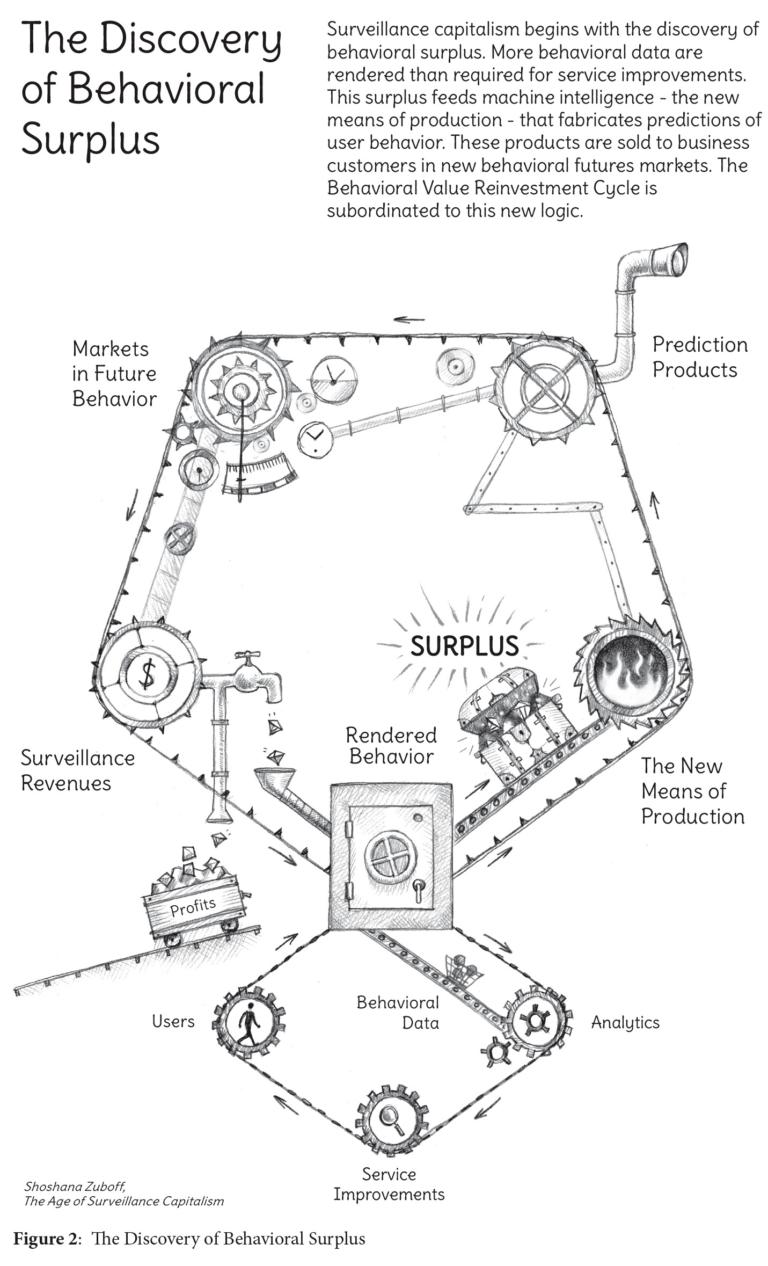 Zuboff, S. “The Age of Surveillance Capitalism” 2020
3. Why it Feels Hostile:
The hostility to human agency isn’t a glitch; it’s a feature.
-
The Goal: Make you predictable.
-
The Method: Tuning, Herding, and Conditioning.
-
The infinite scroll. It isn’t designed for your convenience; it’s designed to keep you in the extraction zone longer. It was optimizied to be addictive
4. The “Epistemic Coup”
Zuboff argues we are living through a silent revolution:
-
Epistemic Inequality: They know everything about you; you know nothing about them.
-
Epistemic Chaos: When profit depends on engagement, truth is meaningless, attention capture, predictability, and herding is what generates profit
-
Result: A fragmented reality, filled with misinformation and political extremism, where we can’t even agree on basic facts.
5. The “Uncontract”
Think about the Terms of Service you click.
-
Zuboff calls these “Uncontracts.”
-
They are rhetorically designed to be unreadable.
-
Why is the language of privacy policies socially hollow? Who is the intended audience? (Hint: It’s not you).
6 The Varian Defense
Hal Varian (Google’s Chief Economist) argues:
-
This isn’t theft—it’s an exchange.
-
You get GPS, free email, and instant answers in exchange for your ambient data.
-
Question for the class: Is the trade fair if you don’t know exactly what you’re giving away? Think about how little you know about all potential current and future uses of this data proxy of yourself.
7. Discussion: Taking Back the Digital Home, a space of privacy
Zuboff concludes her NYT piece by saying:
“We must name the problem.”
-
How does naming Surveillance Capitalism change how you view your phone?
-
If the internet is a hostile territory, how do we build sanctuaries?
Wednesday Slides (Feb 11th)
The Rhetoric of Corporate Responsibility
Analyzing AI Ethics Statements (2026)
Google | Meta | Anthropic | OpenAI
Today’s Objective
Deconstruct how corporate “ethics” function as multi-layered rhetorical acts.
-
Identify the target audience (Markets vs. Publics).
-
Expose linguistic “weasel words” and defensive writing.
-
Compare the strategic positioning of the four AI giants.
The Ethics Paradox
“Ethics statements are rarely about ethics; they are about managing the perception of risk.”
— Adapted from L. Furze (2024)
If a company says “We prioritize safety,” are they promising a moral outcome or building a legal defense against future litigation?
Group Activity
Groups: 1. Google | 2. Meta | 3. Anthropic | 4. OpenAI
The Task: Find specific phrases in your assigned statement that speak to:
-
The Markets (Investors)
-
The Publics (General Users)
-
The Developers (Engineers)
-
The Lawyers (Regulators)
Group 1: Google
”The Institutionalist”
- Focus: Integration and Utility.
- Look for: Universalizing language (“socially beneficial”).
Group 2: Meta
”The Democratizer”
- Focus: Openness and Access.
- Look for: Populist rhetoric (“Open source is the right path”).
Group 3: Anthropic
”The Constitutionalist”
- Focus: Safety and Alignment.
- Look for: Technical-moral hybrid language (“Constitution,” “Safety-first”).
Group 4: OpenAI
”The Altruist”
- Focus: Mission and Humanity.
- Look for: Theological terms (“AGI,” “Humanity,” “Alignment”).
Discussion: What’s Missing?
Look at the margins. Does your document mention:
-
Energy consumption?
-
Data labeling labor (Global South)?
-
Copyright/Intellectual Property?
Silence is a rhetorical choice.
Friday Feb. 13th Slides Writing Lab
From “Happy Talk” to Moral Clarity
Applying Ruha Benjamin to AI Ethics
The Goal for Today
-
Regroup: Finalize your rhetorical analysis. Each group member should pick a different quotation from the statement to work on.
-
Rewrite: Transform a “weasel-word” statement into a concrete moral commitment.
-
Connect: Explain your rewrite using Ruha Benjamin’s framework.
The Radical Rewrite (20 Mins)
Pick one paragraph from your assigned statement.
The Challenge:
Strip away the “Automated Benevolence.”
-
No more: “We strive to…”
-
No more: “Where appropriate…”
-
No more: “Benefiting humanity…”
Write a commitment that actually costs the company something (money, time, or data).
Example: Google
Original: “We will avoid bias that has negative impacts on people, particularly those related to sensitive characteristics.”
Benjamin-Informed Rewrite:
“We will halt the deployment of any tool that fails to achieve parity in error rates across all groups, acknowledging that historical data is a record of past exclusion.”
Part 2: The Benjamin Justification (25 Mins)
Explain your rewrite using one of these concepts:
-
The New Jim Code: How did you stop the tech from being a “shinier” version of old discrimination?
-
Informed Refusal: Where did you draw a line in the sand and say “No”?
-
Default Discrimination: How did you move the “default user” away from the Silicon Valley elite?
“The desire for objectivity is often a desire to be free of the responsibility of being a subject.”
— Ruha Benjamin
Own the subjectivity. Your rewrite should reflect a specific, situated moral stance, not a “neutral” corporate one.
Submission Requirements
Due at end of Class:
-
The Original: Paste the corporate paragraph.
-
The Rewrite: Your revised moral commitment.
-
The Critique: 250 words connecting your changes to Race After Technology.