Monday Jan. 12
Introduction to Course Digital Architecture and Syllabus
Make sure to start reading The Odyssey.
Wednesday Jan. 14
Slide Deck
1. Welcome to Humanities
Before we start, please do the following:
Step 1: Open your copy of The Odyssey to Book 1 and reread the following passage.
-Lines 102-168
Step 2: Turn to your neighbor, introduce yourself
Step 3: Discuss the following:
Where do you see someone acting as a “good” host or guest?
Where do you see the opposite?
Which verbs, objects, or descriptions gave it away?
Be ready to discuss with the class.
2. The Nature of the Poem: From Performance to Text
The Oral Tradition: If a story is never written down, where does it live? In an oral culture, the poem exists only in the moment of performance. The bard does not “recite” a memorized script; they re-create the story through a language of traditional phrases and rhythmic patterns.
How does the “truth” of a story change when it depends entirely on the memory of the speaker and the presence of the audience?
Composition by Formula: The poem is built through “formulas”—fixed phrases like the wine-dark sea or rosy-fingered Dawn. These are not decorative clichés. They are the essential vocabulary of the tradition, shaped by the requirements of the dactylic hexameter.
Does the use of these repetitive, “ready-made” descriptions make the poem less original, or does it grant the characters a sense of eternal, unchanging nature?
The Written Monument: The Odyssey we hold today is a paradox: a written “monument” of a performance tradition. It was likely transcribed at the point where writing technology first met this ancient oral art.
What is lost when a live, improvised tradition is “frozen” into a fixed text?
We are reading a script that still carries the echoes of the song—the repetitions, the epithets, and the formal structures (like the Xenia ritual) that once helped a bard navigate a twenty-hour performance.
3. Key Terms For the Odyssey
Xenia
The sacred law of hospitality and the ritualized relationship between host and guest. Protected by Zeus, it requires the host to provide food and safety before asking questions, and the guest to provide news while respecting the home.
Kleos
Renown or “what is heard” about a person. It is the immortality gained through deeds and stories. While traditionally won in battle, the Odyssey explores how glory can be achieved through survival, wit, and the return home.
Nostos
The hero’s journey toward homecoming and the restoration of the household (oikos). It represents the struggle to return to one’s rightful place and re-establish order after the chaos of war.
Odussomai
A pun on the name Odysseus, meaning both “to suffer/be an object of anger” and “to cause pain.” It suggests the hero’s identity is defined by the endurance of suffering and the toll his journey takes on others.
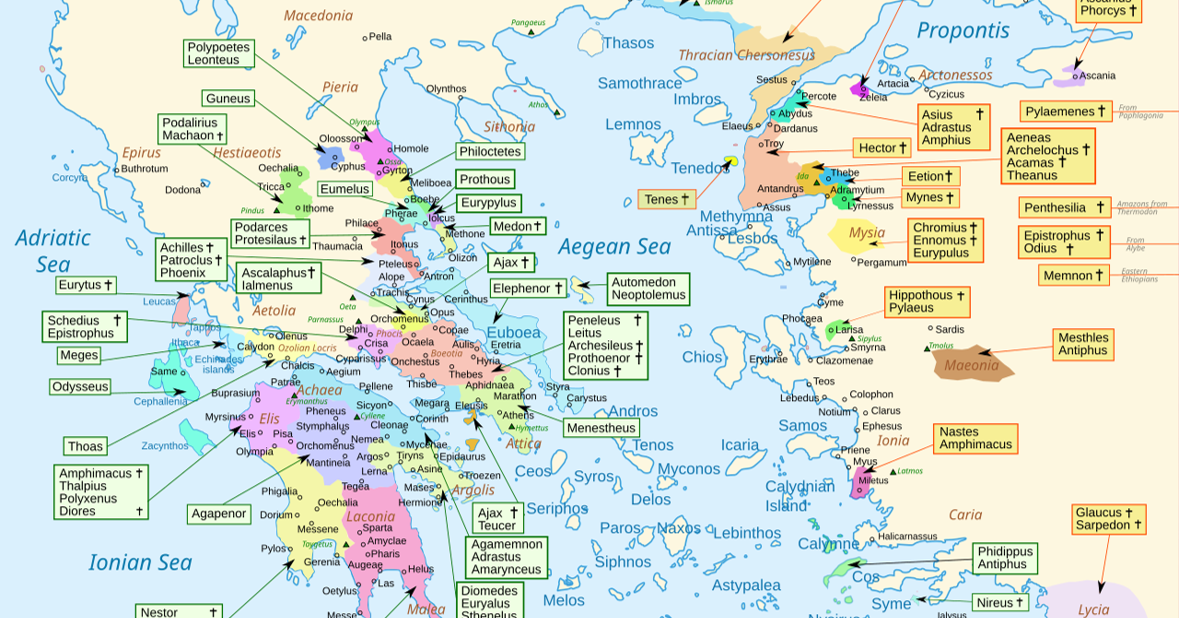
4. Map of The Aegean
5. The Structure of the Odyssey
Books 1-4: The Telemachy
Books 5-8: Odysseus Comes to Phaeacia
Book 9-12: Odysseus Tells the Story of his Travels
Book 12-24: The Return to Ithaka
Why do you think we focus on Odysseus’s for son so long?
.png)
Friday, Jan 16
Slide Deck
1. The Trojan War. Three Key Events
The Judgment of Paris
-The foundational “original sin” of the war. -Eris’s Apple of Discord led Paris to choose Aphrodite over Hera and Athena, resulting in the abduction of Helen. -In Book 4, this lingers behind Helen’s self-characterization as “shameless” (4.145) and the “ordeal” the Greeks endured for her sake (4.170).
2. The Trojan Horse & Divine Wrath
-The stratagem that ended the war but sealed the Greeks’ fate. -Menelaus recounts Odysseus’s steel nerves inside the horse (4.271–289), -However, the Greeks’ subsequent desecration of Troy (specifically the shrines) turned the gods against them, causing the disastrous nostoi (homecomings) that left Odysseus stranded and many others dead.
3. The Tragedy of the House of Atreus -The foil to Odysseus’s family. -Proteus reveals to Menelaus the murder of Agamemnon by Aegisthus and Clytemnestra, followed by Orestes’s revenge (4.512–537). -This serves as a warning for Telemachus of what happens when a homecoming goes wrong and as a model for the vengeance he must eventually take.
4. Writing Activity (for Submission)
-Spend a few minutes with your text. You are preparing for a textual scavenger hunt. -As a test of your knowledge of the book, I will be giving you a few things to find and write about. But there will be a strict time limit. -I am giving you time to prepare. The questions will be about the themes we have discussed today.
5: Scavenger Hunt
For Submission on the course website on the assignments page. Write in a .doc file and submit as a .doc or .pdf. Label each answer by number.
I: In Book 1, Zeus discusses Aegisthus. What is the specific lesson Zeus says humans should learn about their own suffering?
II: In Book 3, find where Nestor explicitly compares Telemachus to Orestes. What specific quality does Nestor say Telemachus must display to “win a name for himself”?
III: In Book 4, Helen tells a story of Odysseus entering Troy. Describe the specific physical disguise he used and how it contrasts with the “bloody” death of Agamemnon.